Blackwood estate fence and gates
We Have Always Lived in the CastleThe Blackwood estate fence and gates define the boundary between the village and the Blackwood home. Built to enclose the family’s land and close a public shortcut, they regulate who can approach the house and by which route. For Mary Katherine Blackwood, their locks and barriers promise safety; for the family, they also make privacy a visible claim over land and access, a claim that proves vulnerable when Constance gives Charles Blackwood a key.
Construction and Setting
John Blackwood built a wire fence along Blackwood Road, which curves in a great circle around the family’s land. The property’s boundary extended from the highway to the creek, enclosing the land between the highway and the river. Near the town hall, a large black rock marks the entrance to the path Mary Katherine takes home through the woods; there she unlocks a gate and locks it behind her. A second gate stands at the far end of the path. Both gates have padlocks and signs marked “PRIVATE NO TRESPASSING.”
The barriers changed how villagers could travel. Before John closed the path, people used it as a shortcut from the village to the highway’s four-corners, where the bus stopped, saving perhaps a quarter of a mile. The route passed the Blackwood front door, a prospect their mother disliked. Her rule of privacy is blunt: “The highway’s built for common people,” she says, “and my front door is private.” The gates therefore do more than mark a property line: they redirect ordinary passage away from the house.
Routes and Social Boundaries
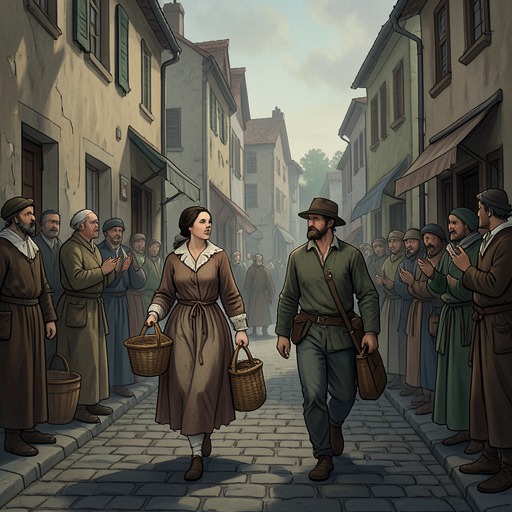
The gates distinguish between people who may enter and those who must remain outside. Properly invited visitors approach by the main drive, which runs from the gateposts on the highway directly to the front door. Mary Katherine imagines that drive as a route for the “good people,” dressed in satin and lace, while villagers on the old path seem to her to move furtively and servilely. The contrast belongs to her childhood fantasy, but it reflects the physical arrangement: the family’s chosen entrance is open to invitation, while the former shortcut is locked.
That separation also sits within a larger local divide. The Blackwoods own the land between the highway and river, while village residents use roads and public spaces that pass near the estate. From the black rock, Mary Katherine enters the family’s enclosed woodland and considers the house home. As far as she knows, no villager has tried to use the closed path since John locked its gates. The signs and locks thus work partly through their evident authority: the padlock is simple enough for a child to break, but Mary Katherine believes that the prohibition itself keeps people from crossing.
Maintenance and the Promise of Safety
For Mary Katherine, the boundary is not secure once and for all; it requires repeated attention. Every Wednesday morning she walks around the fence to check that its wires have not broken and that the gates remain locked. She can wind torn wire back together and tighten loose strands herself. Completing the inspection reassures her that the family will be safe for another week. The circuit turns upkeep into a recurring household ritual, and the fence’s condition becomes a measure of whether danger has been kept out.
Her confidence in the enclosure extends beyond its visible materials. The wooded path is dark and overgrown, and she knows its turns and hidden ways. She checks the gate’s padlock after entering, testing that it holds; once it is fastened behind her, she feels safe. On Sundays she also examines objects buried around the land, including silver dollars by the creek, a doll in the long field, and a book nailed to a tree. These private safeguards are not parts of the fence, but they belong to the same protective system in Mary Katherine’s understanding: the boundary is reinforced by locks, familiar routes, and things hidden in the ground.
Access, Breach, and Aftermath
The gates do not give Mary Katherine permanent control over who enters. When Charles Blackwood goes to the village, Constance gives him a key to the gates, along with a shopping list and money. There had originally been a key for each member of the family, kept on a rack beside the kitchen door; Charles receives one of the old keys, perhaps their father’s. The act makes him an authorized entrant, but it also weakens Mary Katherine’s assurance that the house is protected simply because its gates are locked. Later, Charles’s saucers are scattered through the house rather than kept on the pantry shelf, another sign of his presence inside spaces Mary Katherine regards as properly ordered.
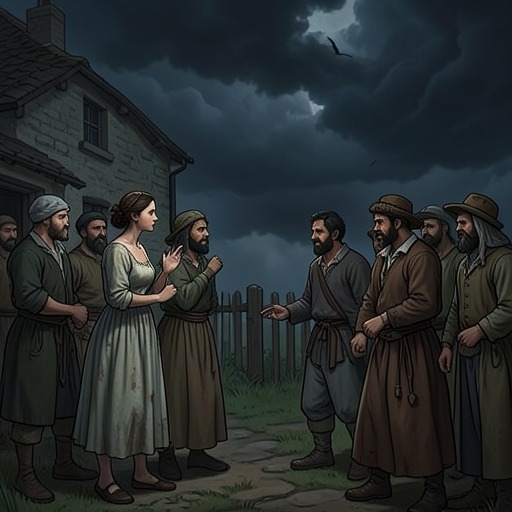
After the house is wrecked, its interior offers a stark measure of how little a boundary can preserve once it has been crossed. The kitchen table blocks the door; chairs, dishes, food, and generations of household silverware lie broken or scattered. The small rose-patterned sugar bowl is damaged, while the cellar preserves remain untouched. Mary Katherine thinks the attackers found the sugar. In the aftermath, the sisters rely on barricades they can watch from the vegetable garden rather than on the estate gates alone: they leave the kitchen door open only when they can see whether anyone is approaching and can run back if necessary. Ash remains on the gathered vegetables, and Mary Katherine fears that smoke has entered the ground. The defensive boundary has shifted from the perimeter of the estate to a closer, watched line around the damaged house.
Significance
The Blackwood estate fence and gates embody the family’s attempt to make seclusion physical. They separate the invited visitor from the unwelcome passerby, the main drive from the shortcut, and the house from the village. Mary Katherine experiences that separation as refuge, but the story also shows its limits: a key can be handed to Charles, and locks cannot prevent the destruction that follows an incursion. The fence promises safety as a structure; its weekly inspection and Mary Katherine’s private safeguards reveal how much that promise depends on continual vigilance and on the family’s ability to control access.